Baby Sleep Secrets
1. Day calories.
Most importantly, I try to get my babies all of the calories they need during the day. This includes waking them every three hours to feed (start of one feed to the next) during the day (I never, ever wake them at night - if they are sleeping, they are not hungry).
2. Feed on waking.
My sister's philosophy is that the hardest thing a baby does all day is eat. A well-slept baby will feed better, and a well-fed baby will sleep better. Contrariwise, a tired baby will not feed well, and a poorly-fed baby will not sleep well (or long).
To make sure they are good and awake for the feed, I change their nappy/diaper and feed them as near naked as the room temperature will allow.
3. Focus on a breastfeeding mother’s caloric consumption.
It is difficult as the mother of a newborn to eat well, but I try really hard to eat well and in good-size quantities. This is not the time I worry about losing the pregnancy weight. I try to eat plenty of protein and vegetables, and not worry about fats all that much. (I do try to avoid sugars, including simple carbohydrates.)
4. Swaddle tightly.
Babies will wake themselves up through involuntary hand and leg movements. Swaddling helps prevent this problem and recreates a womb-like environment where they are nice and tight. Babies don't often like the process of swaddling, but like its effect. I swaddle as tight as I possibly can to prevent as much movement as possible.
This requires the right kind of fabric. My favourite is a stiff, lightweight flannel, which is hard to find here in the UK. I also use a diaper pin (the kind that has a safety latch) and pin it right at the shoulders, preventing (usually) the hands from ever reaching the face.
Finally, my sister taught me to build in towels or other cushions around the baby to make them feel extra secure – a towel on both sides and a thin blanket tucked in around the body - but never further than half-way up the chest.
These are the basics of what I do, and the most important.
5. Side sleeping.
Sleep them swaddled on their side at first, then un-swaddled on their tummies once they can move their heads.
In the UK, the universal advice is to sleep babies on their back because of SIDS, the thought being it is somehow safer. Yet babies could asphyxiate much easier on their backs. My sister Anje (the mother of 9 babies she taught to sleep through the night early on) believes it is equally safe to side-sleep, if not safer, and that babies sleep better in this position. She taught me to sleep Gideon (swaddled) on his side, propped up by rolled blankets or towels. For Esther, I use stuffed animals.
Once they can move their heads back and forth, my sister sleeps babies on their tummies, unswaddled, as this is the position best for sleep. Unswaddling them at this point makes sense if you are sleeping them on a flat surface, as their arm and leg movements are less likely to wake them up, because they are stopped by the mattress. I have to swaddle for a bit longer, as our newborn trug is just a little curved. I am now in the process of un-swaddling Esther, as she has almost grown out of the trug, and will soon sleep her in our baby hammock.
6. Make sure they are getting enough day sleep, but not too much.
A well-slept baby sleeps better. My little Esther's best nap is her first, then the next, and on down through till her fourth nap at the end of the day, which is fitful and very short. (I'm working on the afternoon nap to be longer, as she'll keep this the longest.)
Although above I indicated that a baby should be woken every three hours to feed. This is generally true. However, for the last feed of the day, you have to get them to sleep for the hour or half hour immediately before so they have enough energy to eat.
This can be a tricky math problem. Gideon couldn't stay up longer than an hour till he was 4 or 5 months, but then wouldn't sleep longer than an hour. Esther did well at this until about a month ago (she's nearing 12 weeks). She would be awake for 40-60 minutes before sleeping for two or more hours, so the three hour schedule worked well. But now she needs less total sleep, but can still only be up for up to one hour and 15 minutes, usually less.
As I mentioned above, her naps get progressively shorter throughout the day. Her first nap is from 7:30 to 9:30 or 10:00 a.m. The next is suppose to be from 10:30 or 11:00 a.m. to 12:30 p.m. in order to stay on schedule, but she can usually only make it till 11:45 or 12:00. By 12:30 p.m. when she is suppose to feed, she is too tired to feed and then everything is thrown off, she has to take a short nap, and then she reverts to snacking rather than getting really good big feeds that will last her three hours.
In order to have her sleeping before the next feed, and to "save" some of her sleep for the important afternoon nap, I have started waking her at 11:30 a.m. for 30 minutes, and then let her sleep from 12 to 12:30 p.m. before her feed.
I have found that as my babies get more tired throughout the day, they need more help getting--and staying--asleep. The first nap usually requires very little in terms of helping them to sleep, but they can need more cuddles, white noise, or darkness throughout the day (see items listed below).
My sister says that you have to teach babies to sleep, and when. She bounces her babies, held on their side, to sleep, patting their bums, until nine or so weeks, when she starts putting them down barely asleep, then works backwards till fully awake. I spent countless hours when Gideon was little getting him to sleep each time till he was 4 months when he learned to put himself to sleep thanks to our sleep-trainer nanny. With Esther, I started just putting her down from day 1, and that works - usually. If I miss her window (more below), I have to do more work and use more props (white noise machine, binky/dummy, and darkness).
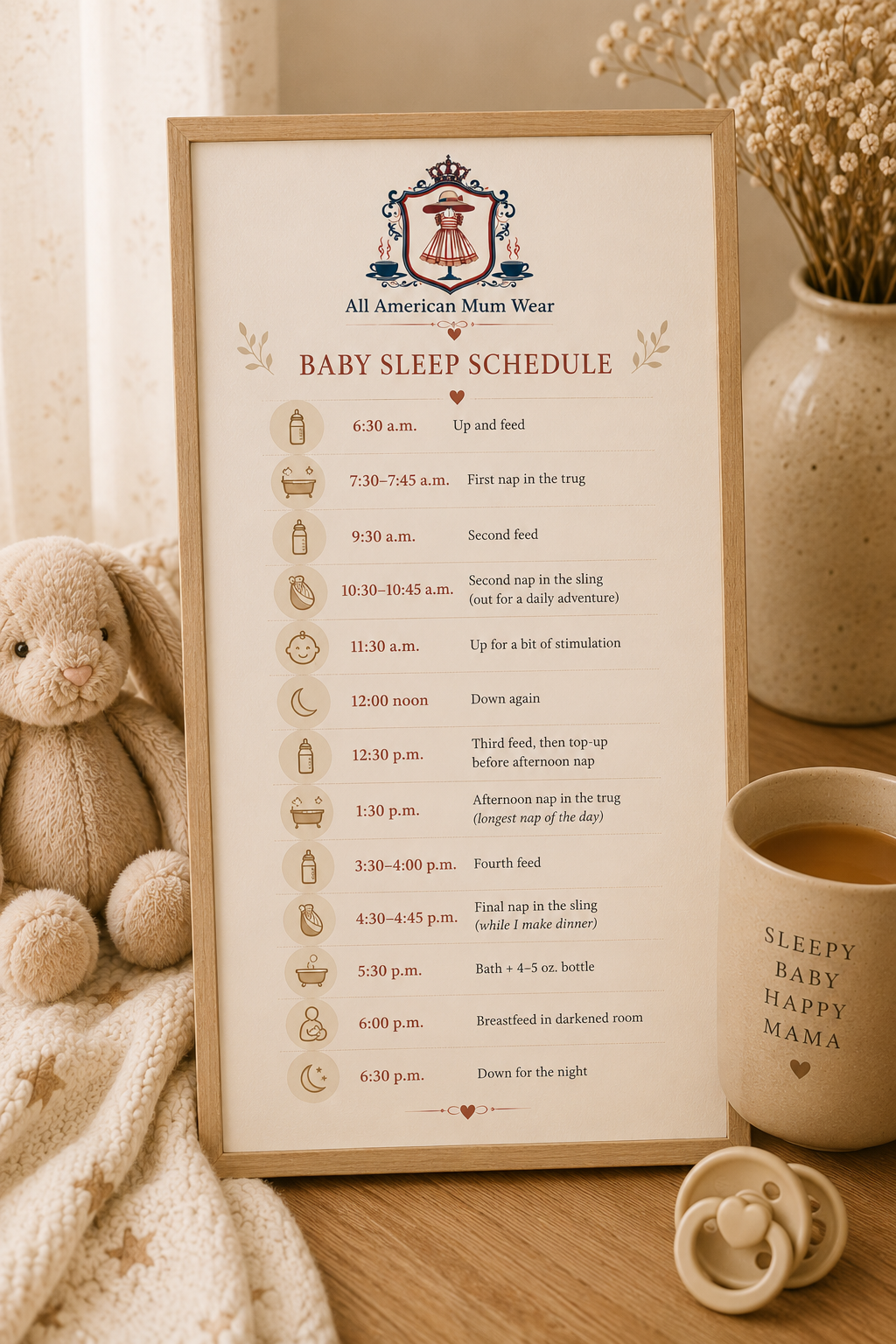
Ideal schedule at 11+ weeks is as follows:
6:30 a.m. up and feed
7:30-7:45 a.m. down for first nap in the trug
9:30 a.m. second feed
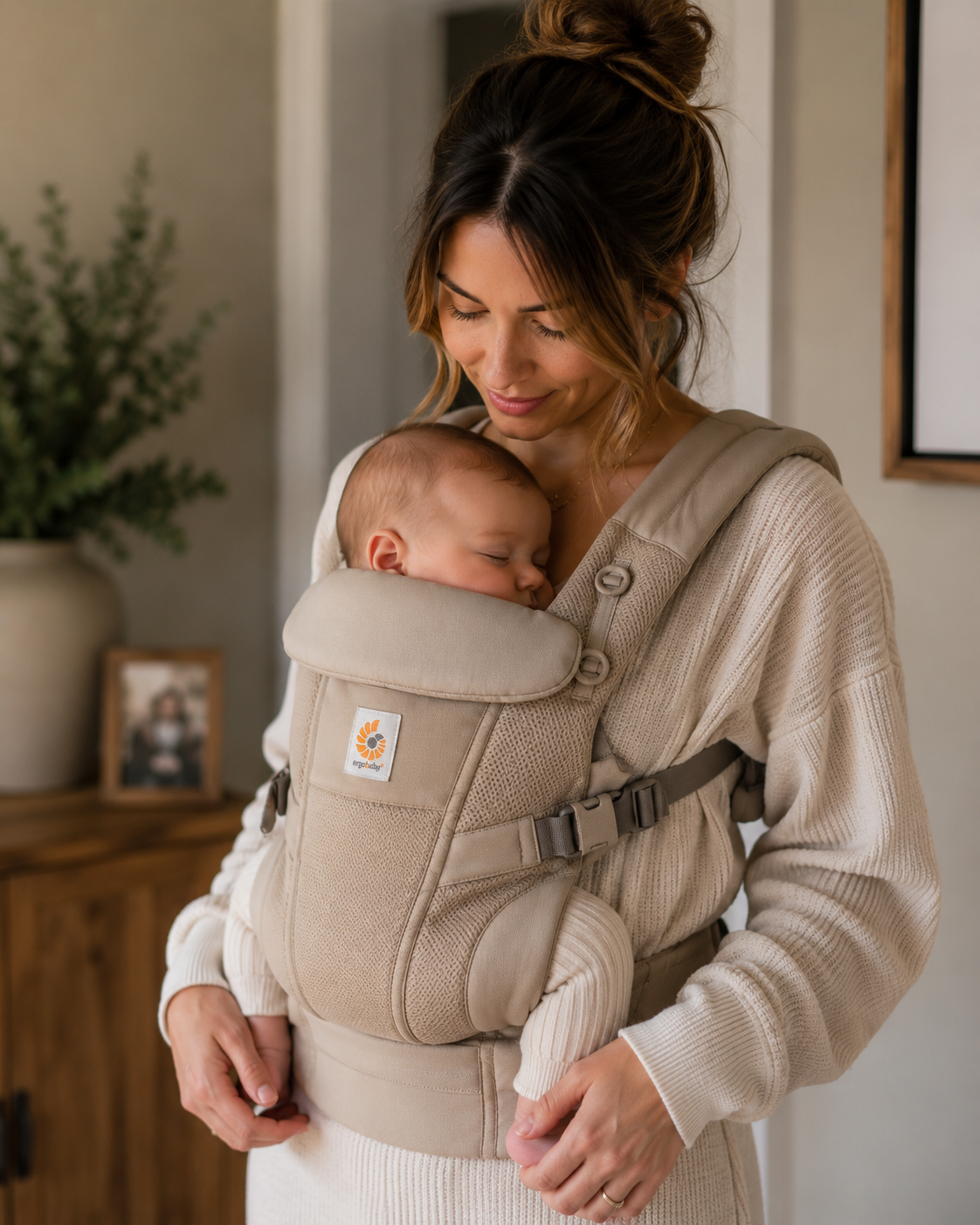
10:30-10:45 a.m. down for second nap, usually in the sling, as this is when I go out with G for his daily adventure. (If I had a double stroller/push chair, she'd probably sleep in it, but I'm attempting to avoid one at all costs. When G gets evicted from the stroller when he turns 2 in March - when he'll need to stand on a boogy board or ride along on the scooter - she'll probably nap in the stroller.)
11:30 a.m. up for a bit of stimulation
12:00 noon down again
12:30 p.m. third feed, then another top-up right before the afternoon nap.
1:30 p.m. afternoon nap in the trug- this one is currently the hardest. In order to get her to "sleep" through this one, I have been spending the better part of the hour between 2:30 and 3:30 p.m. rocking her trug, shushing her, or bouncing her in the dark the last few weeks to make sure this "nap" lasts long enough to stay on schedule. I thought I had this sorted yesterday when, after two days of waking her during her mid-morning nap, she slept through. But then things went south today - we'll see! In short, getting them to sleep long enough takes WORK and I can only do this because Gideon is asleep at this time.
3:30-4:00 p.m. fourth feed
4:30-4:45 p.m. down for final nap in the sling while I make dinner
5:30 p.m. bath, 4-5 oz. of expressed milk in bottle
6:00 p.m. breastfeed in darkened room
6:30 p.m. down for the night
7. Don't put them to bed overtired.
Not only is there an “overtired” state in general, resulting in permanently crabby babies, but there is a discrete overtired state when you miss their window to go down to sleep.
My children have a window during which they can be put down to sleep easily. Put them down too soon and they are upset because they aren't ready to go to bed/get bored in the dark (and you can get off schedule because they can't sleep till their next feeding time); put them down too late and they are a tired mess who need lots of help going to sleep. Gideon was much harder, as he was colicky, but Esther has a definite easy window. I watch for their tired cues. They are usually squirmy and a bit shouty and then start sneezing. Then there are the yawns - usually three about a minute or two apart. Then the seven-mile stare. Then if they are not already in bed, they can quickly transform from happy little cherubs into demons of the blackest hell.
If I let G get to the yawns, it was already too late. Esther is much more flexible. If I'm on top of things, however, I try to start swaddling Esther when the sneezing begins and things are smooth sailing.
The other tough thing about putting kids to bed overtired is that their sleep cycles, normally 50-60 minutes, are diminished, sometimes to 30 minutes, but it can even go as low as 10 or 5 minutes. (More on sleep cycles below.) Worse, they are not rested enough to have the energy to seamlessly transition from one sleep cycle to the next. This means they can get really fussy and may not be able to make the transition themselves. This effects transitions at both the beginning of the nap or night sleep or at the end of the nap or night sleep, resulting in a crabby baby from waking too soon.
8. Sleep the baby in another room.
This secret goes against SIDS advice, which is to sleep them in your room for six months. I, however, am an exceptionally light sleeper, so I face the option of either sleeping with them out of the room or getting no sleep with them in the room. I follow all other SIDS advice (but for sleeping them on their backs), including the most important, related to fresh mattresses and sheets, and sleep my babies far enough away that I don't hear every grunt, but close enough that I hear their cries, usually in the next room over with a closed door between us.
For Gideon, this meant he slept in the bathroom beginning at three weeks. For Esther, it meant she slept in the living room/lounge the first night (after having her in my room all day and not sleeping). I think there was a direct correlation to how soon they slept long hours through the night. Gideon started consistently sleeping seven-eight hours through the night at four weeks. Esther was consistent at 10-12 hours at four weeks, but she would go nine or 10 hour stretches almost immediately, if not consistently.
I'm convinced the correlation is due to two factors: not only can we not hear every grunt and are therefore responsive only when it's serious, but they can no longer smell their mothers. If I'm not mistaken, smell is one of the most developed of babies' senses at birth. It makes sense to me that if they can't smell mother's milk, they are more likely to sleep through their transitions (see below for a discussion of sleep cycles).
9. No stimulation during night feeds.
My sister taught me that you need to teach babies the difference between night and day, including when they wake in the night for a feed. This means the light should be kept as low as possible, and there should be no talking and no eye contact during the twelve night-time hours. After eating, they are put straight back to bed. I still do this with my toddler when he wakes in the night when sick or from a loud noise. He knows if it is dark, it is time to sleep.
10. Night routines.
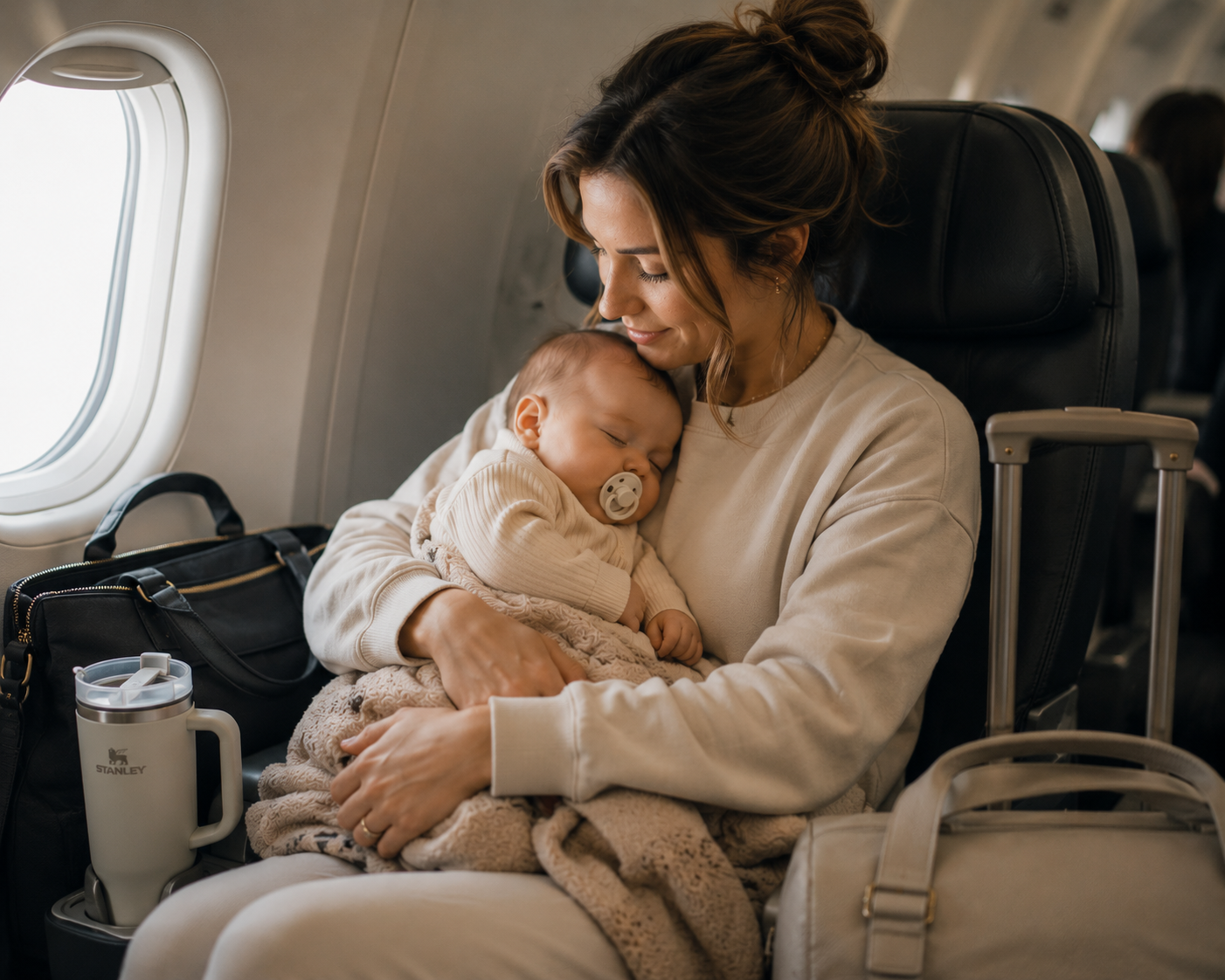
Another teaching of my sister is to differ the going to bed versus the going down for a nap routine. Nap routines for me involve swaddling (prior to three months), singing to them the same song, and patting their bum once they are in bed. Night-time involves a bottle and breastfeed, bath time, and being fed the last little bit swaddled in the semi-dark before being sung to and kissed near their basket. I try to do everything at the same time and in the same way. When traveling, I try to follow the same routine as best I can, even if on an airplane (Gideon's received several "baths" in airplane lavatories).
11. Props.
A final teaching of my sister is that any and all props are welcome, but you want to be careful how much you use, and save your biggest ammunition for emergencies.
Whitenoise - I use the heavy whitenoise machines when my babes are seriously over-tired. (Light whitenoise such as a bathroom fan is used pretty liberally.)
Dummies - I use pacifiers/dummies more liberally, but try to get by without them. (I'm seriously failing at this, however, in that Esther now refuses to go to sleep during the day without one - at night she knows somehow at three months that she can't have it. Any help out there for this problem?) My mother admits to using hair tape (really gentle tape) to tape in the pacifiers. They can still breath, cry, and spit up as necessary. The tape is gentle enough that if the baby wants to spit the pacifier out, they can.
Blankies/soft toys - My son has a muslin he has adopted as his ever-steady prop, which is fine because it is interchangeable and therefore washable and portable.
Darkness - I would like to use darkness less, but both of my children need it desperately. Gideon used to need pitch blackness, and Esther isn't far off. They are both easily over-stimulated, so they easily wake in their transitions if there is light and therefore discernible objects to look at. I blacked out the bathroom for Gideon using black felt around the door. We have shutters in our current flat, so it is easier to create the needed darkness for Esther, but I still black out the door to her sleeping area by covering the door windows with a towel. When out and in baby carriers, I have to put a breathable blanket over Esther. Gideon no longer sleeps on the go, unfortunately, making me homebound during his naps. A friend used tinfoil to black out her windows - something you need to be careful with because of its impact on temperature control - but the darker room helped her baby sleep better.
12. Listen.
When one of my babies starts crying, before going in to rescue them, I listen. I've found there are different cries for different things. Gideon is capable of fake crying to manipulate me, bless his heart. These cries are ignored, and he's doing them less. Cries of pain are responded to immediately. Pain cries can mean there is trapped gas that needs to be released or, in Gideon's case, when he is sick and needs to throw up (sorry to the non-parent readers - reality reigns supreme the moment a baby is born). Night frights, shrill, spontaneous crying, will die down quickly, and are easy to confuse with pain cries. I've found it best to wait these out a few minutes to distinguish the two - night frights will dissipate quickly, whereas pain cries will not. I now know with Gideon what is what, and will rush in with pain cries and not with the other.
More often than not, my children will cry a bit when they are in "transition." I have mentioned this before, but baby sleep cycles are 30-60 minutes long, during which they progress through Rapid Eye Movement and all levels of sleep that adults do in 90 minutes. In between cycles, they wake a little bit and will often squirm, cry a bit, and even open their eyes. If they are well-rested, they will have the energy (sounds funny, but it's true!) to put themselves back to sleep. If they are not well-rested enough, they will cry more - sometimes up to five minutes. If they are extremely overtired, they will need help going back to sleep. It is very important not to disturb babies in transition unless they keep crying after five minutes, as doing anything will wake them further and make them more overtired.
Gideon goes into light sleep between 5-7 a.m. and during the last 30 minutes of his long afternoon nap. Both times, he will cry a bit during transitions. If I wake him (thinking he is done sleeping) during this time, he will be terribly cross with me and with life. I have learned to just leave him a bit until I am sure he is done sleeping - wherein he usually has a "come and get me, I'm bored" cry rather than an angrier transition cry.
Sounds complicated, but it's really not!
13. Be respectful.
Finally, I had to learn when Gideon was little (again from my sister) to be respectful of my children's sleep needs. Especially for the afternoon nap and their night sleep. I'm much more casual with their morning naps (or Esther's final, short nap before the nighttime routine). When I am not respectful of their needs, they fall apart and are messes.
Respecting my children's needs means that I need to do everything I possibly can to get them to a place where they can sleep in the dark in their own bed--on time. They always sleep better (and longer) under these conditions and will therefore generally be happier.
Obviously, some flexibility is needed when traveling. However, I still do everything I can to recreate good sleeping conditions—at the right time. I plan for travel by having my children sleep in portable beds on a regular basis (basket, hammock, and a tent thus far) that travel with us. My sister planned ahead for travel by sleeping her children in travel cots/port-a-cribs for their afternoon naps so they became accustomed to sleeping in their travel bed.
When I am not traveling, I can pretty much plan the rest of my life around afternoon naps and night sleep. It was a massive mental adjustment to live this way, but my children and I (and likely my husband!) are so much happier because of it.